Edit, Post & Music
- 29 January 2026
- 5 min read
The work of the editor is often underestimated. One might think that they simply string together the clips as they were originally conceived. However, this is the exception. In The Creator, for example, the rough cut was five hours long and had to be edited by the editor to a normal film length of about two hours. And indeed, the result works without seeming rushed, because the editor was able to tell the story in a perfect flow within the set framework.
Here is a review of our editing work.
Editing
To import the material, I needed VST's assistance again on February 5 and 6 in Saalfeld. On site, we copied all the data from the HDV tapes in the camera to our external hard drive using an editing computer. And, as if I had known it would happen, two of the four tapes had long dropouts. Entire takes were missing, and in one shot, all of them were missing. I only had one take for two shots.
Even trying to import the tapes with a different camera didn't help. In the end, I had to work with the material I had. The editing and initial sound editing were done in parallel. A total of six sequences had to be edited using the shot-reverse shot principle. For the two most important sequences, the conversation at the table, I used the same material from each camera. This allowed me to cut at any point. The final film was therefore only created in the editing room.In Ilmenau, I was able to edit the entire film on my laptop. Since the selection of editing software for HDV 720i 25p material is very limited, I decided to use Adobe Premiere Pro 2.0, as I had no experience with Canopus and Avid Liquid 7 anyway.
The initial consultations with my professor regarding the rough cut resulted in urgent cuts. There were lengthy passages in the middle section and the ending was too ambiguous. What no one noticed at first glance was an irreparable continuity error. Neuhäuser first took off his glasses and placed them on the table, but then suddenly put them back on in the middle of the conversation. He kept them on until he and Borowski got up together.
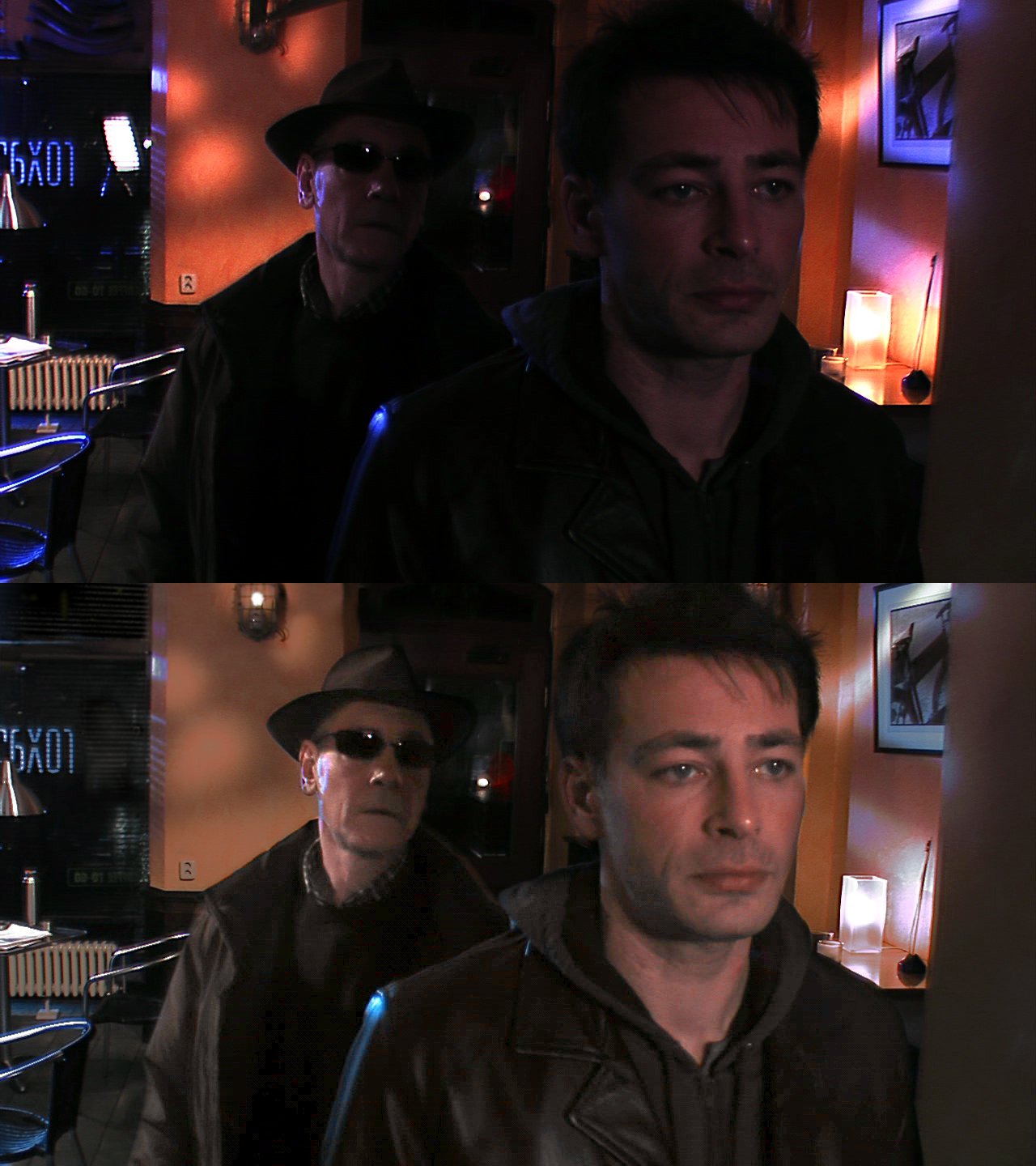
For color correction and a few more intensive post-processing tasks, I used Combustion in Weimar and Photoshop for mate paintings. The work was more intensive than expected.
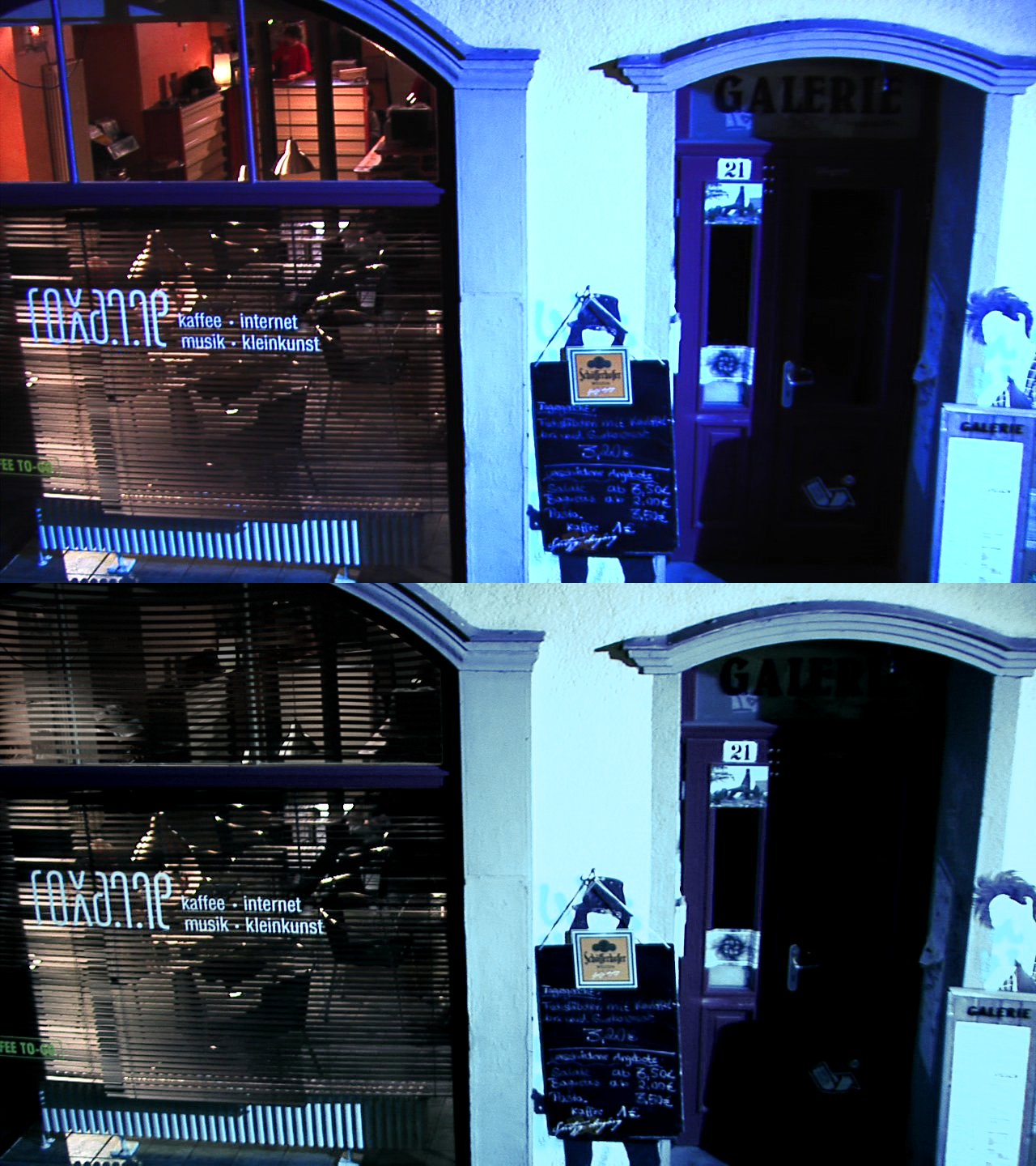
Thanks to the high resolution at the time (1280 x 720 pixels) in full images and the good quality of compression in MPEG 2 format, I was able to brighten areas that were too dark considerably. Until then, this had been virtually impossible with DV footage.
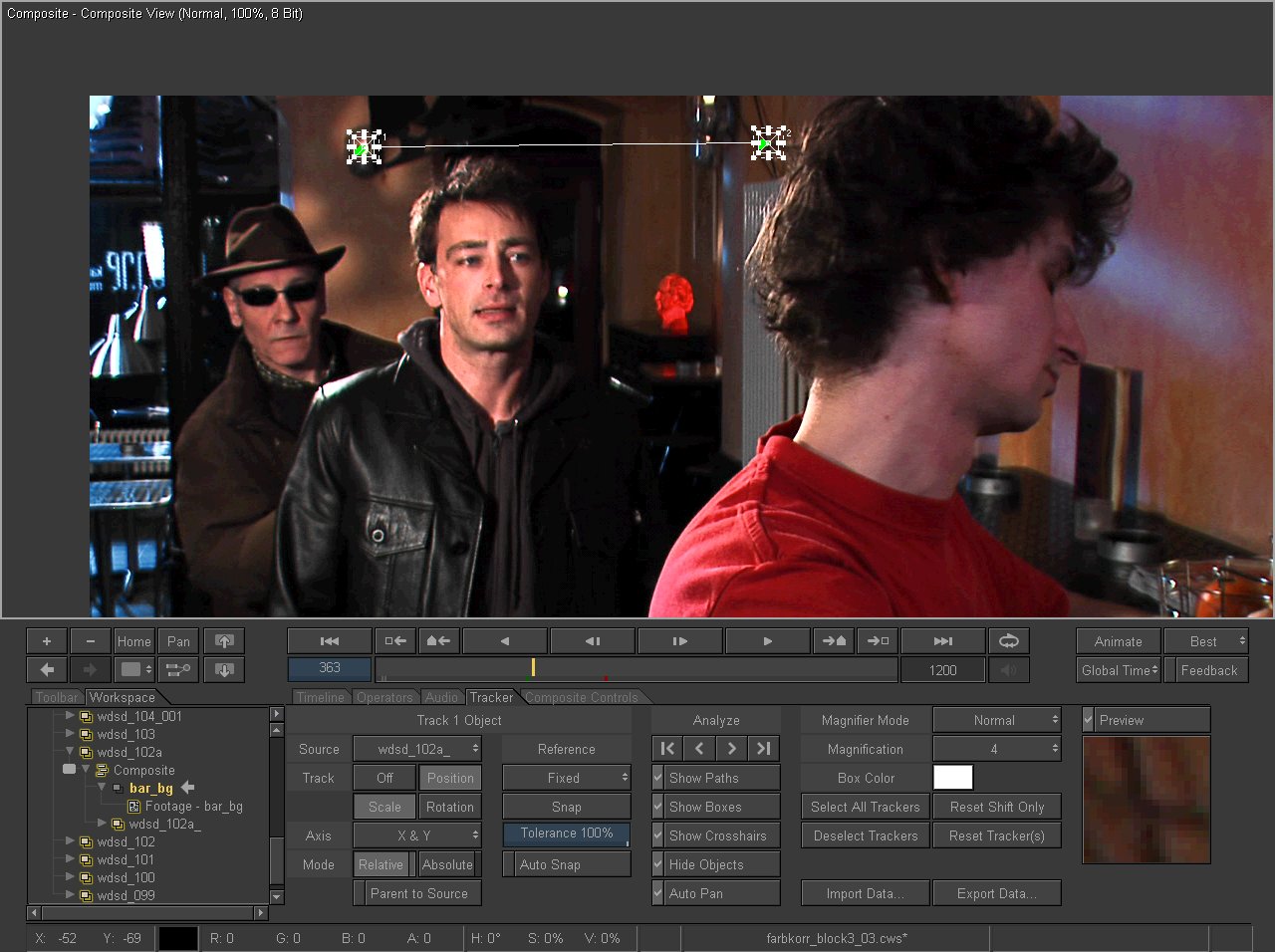
The blood animation in the floor tile grooves was created in 3DS Max at the Bauhaus-University Weimar. Realflow, a standalone fluid simulator, was used to animate the liquid.
Sound
Due to the constant muffled noises coming from next door in the C basement, I was worried whether the sound would be usable at all. To my surprise, it was much better than expected. Constantin Popp had done a really good job as sound engineer. Only in one place at the bar can you hear a faint rhythm in the original sound. Here, I hoped that the background music would cover up the distracting rhythm - which fortunately was the case.
I was also pleasantly surprised by how committed and independent Constantin was in taking care of the sound editing. As a sound engineer, he re-edited the final sound cut from additional sound recordings made on a laptop in order to edit parts of it better and create transitions.
We set up a little sound recording session at Roxanne's on March 5th to get some extra footsteps, bar noises, people getting up from the table, and money being put from the cash register into a bag. Once it was edited and mixed, Constantin sent me the sound file, I swapped it out with my camera audio, and the final cut was ready.
Music
To underscore the atmosphere on location, the film needs music that would play in the background of a bar, and I should encounter that at a concert by the Christoph Bernewitz Trio at the Kasseturm. I arranged a recording session with Christoph for a Monday, but unfortunately he canceled on me the Friday before. Luckily, I happened to be out and about that day and met two students, Nikita and Nils, who were playing fantastic jazz music on Schillerstraße with a guitar and saxophone. And they enthusiastically agreed to participate.
Constantin and I approached the two of them in a recording studio at the University of Music Franz Liszt Weimar after we had watched the film and discussed the musical mood. Nils played his saxophone superbly. He improvised a wonderfully lively jazz piece to Nikita's pre-determined guitar chords. Together, the calm guitar and saxophone, combined with the bar noises and the conversation between the two protagonists, created exactly the spatial sound atmosphere I had in mind.
Summary 2026
At the first official screening, our finished film received very mixed feedback. The camera work and lighting were praised, but the script was criticized. So we re-edited the film and shortened it even more. And yes, today I would write the story very differently. But I still have wonderful memories of the shoot and working with everyone involved. This little story is still atypical for student films today - and that's exactly what makes it so special.
