Organization & Filming
- 21 January 2026
- 8 min read
Actually, you could be happy. The script is finished and the story has found its framework. But now you're faced with a lot of complicated questions: Who should play the characters? Where can the story take place? Who will want to participate in the film shoot, and what technology will be used to shoot the whole thing? Organizing all of this is a feat in itself. Fortunately, Doreen already had the right skills for it back then.
Organization
With the finished script in hand, I contacted McDonald's and Burger King to request permission to film for three nights. However, after just a few phone calls, the PR ladies who had initially been so nice on the phone now had only one clear message: no chance! For McDonald's, the organizational effort was too great, whatever that meant, and Burger King didn't want to give the wrong impression.
Camera Crew
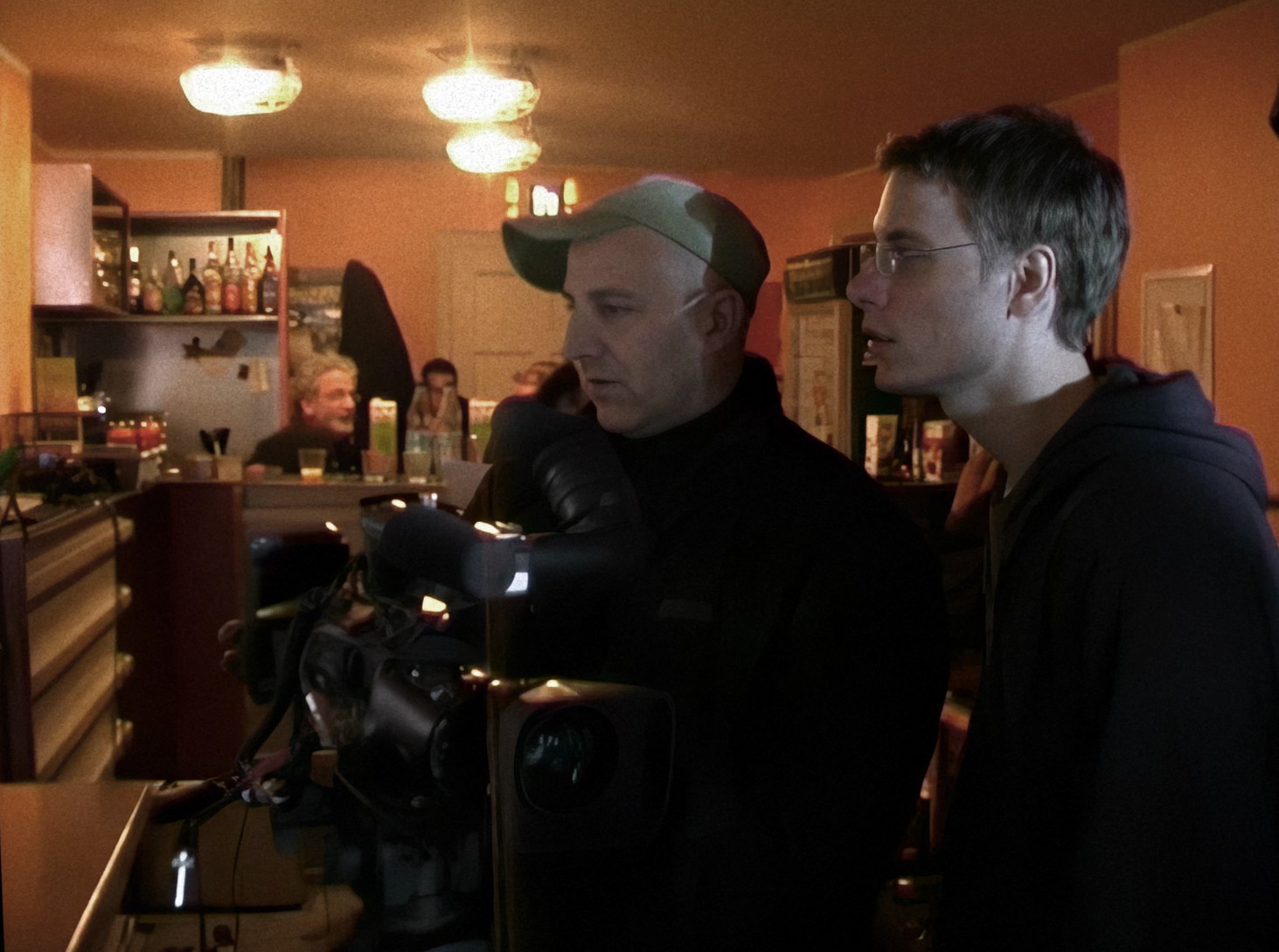
At the beginning of January, I called Egbert Bertram, a cameraman from Erfurt, to ask if he had time and interest in my production. Until then, I had only seen the visually appealing results of student projects he had worked on. Once he agreed, we were able to clarify the initial technical details: what type of camera does he use? How will we shoot? What else do we need? Carina Bachmann joined him for the stage lighting, and they later proved to be an excellent team. During this time, I had a lot of support from Doreen, who kept the chaos under control. She searched for suitable actors from internet agencies based on my ideas.
Cast
Ezard Haußmann, father of director Leander Haußmann („Sonnenallee“, „Herr Lehmann“), responded to our inquiries for the role of Neuhäuser. He told me that he himself didn't like the story very much, but his wife and his agent ultimately convinced him to take the part. One day later, on January 7, I received confirmation from Jan Sosniok, who was to play Borowski but was only available until February 2. I still didn't have a location, but I told the two of them to be ready for January 30 to February 1. That was just three weeks before filming, and there was still a lot to organize: the team, the location, the technology, the third actor, meetings and arrangements, shopping at the hardware store and Ikea for the set, catering, all the transportation, and everything else that you don't see at first glance but have to plan for. I was worried.
Two weeks before the start, Doreen and I drove to Berlin to meet both actors. The discussions were both substantive and organisational in nature: Haußmann had clear ideas about his accommodation and working conditions. I promised to accommodate him as much as possible, and we parted on good terms.
Back in Weimar, I found the rejection in my email inbox. Haußmann was uncomfortable with the idea, and rehearsals at the Berliner Schauspielhaus were set to begin on February 2. But after doing some research, I was able to secure Reinhard Friedrich for the role at short notice. After a conversation with him in Erfurt, I was certain: he was born for the part.
While searching for the second JVC HDV 100 camera, I found help from the Saalfelder technology supplier VST-Pro. We agreed that I could have the camera for a week if I could find and pay for insurance for it. Looking back, it was a really helpful gesture.
Filming location
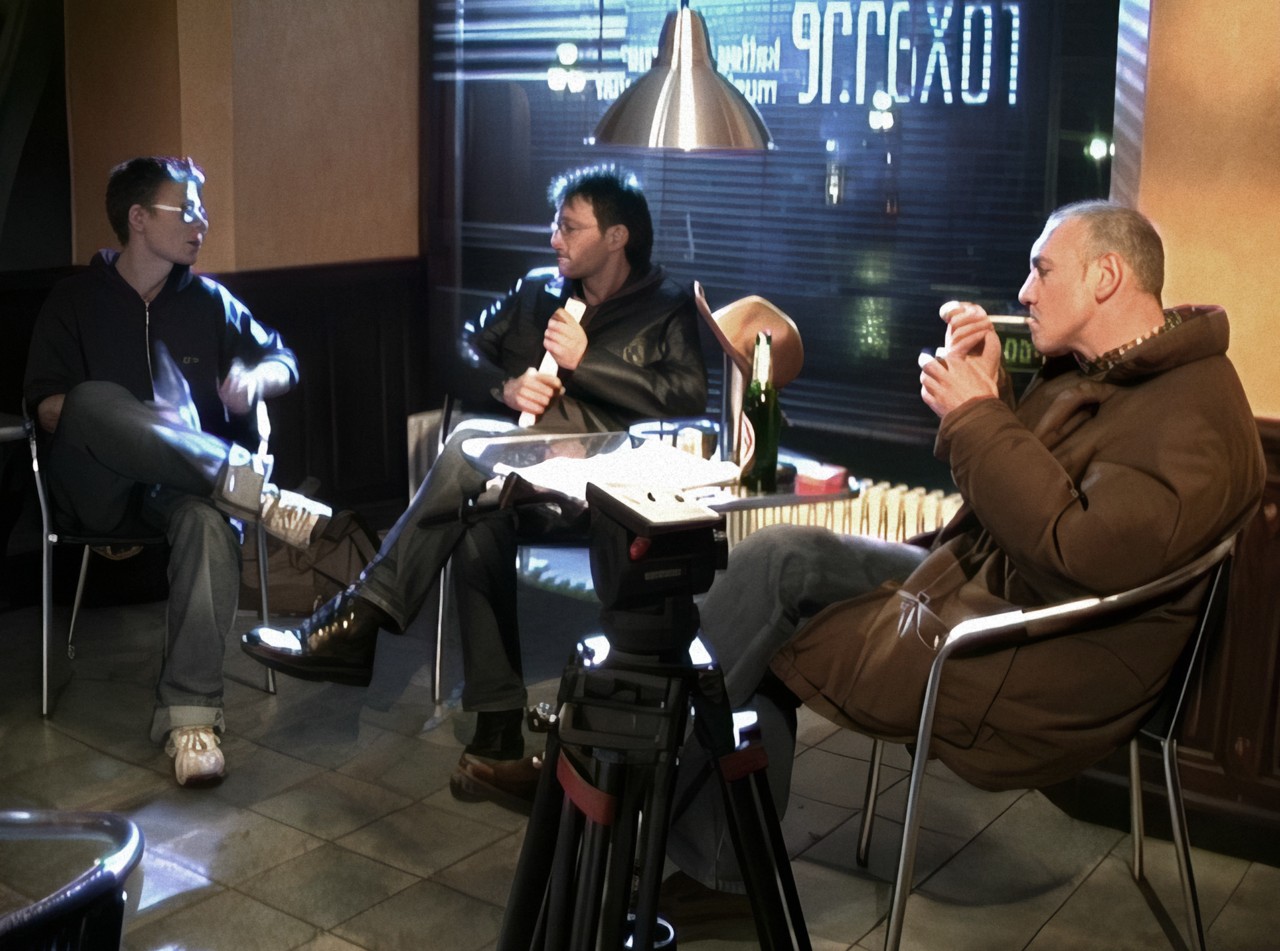
The problem of the filming location remained. In retrospect, I found it incredibly difficult to get away from this fast-food vibe. It was only when the final definitive rejection came on January 18 that I started looking for suitable restaurants and bars in Weimar. We found the student-oriented pub "Planbar," an Italian bar, an independent sandwich bar, the "La-La-Bar," and a rather autonomous-looking music café called "Roxanne." The latter was where I could best imagine the story unfolding, and we were able to reserve the place for two nights and the time in between. Of course, this came at a considerable cost. On January 24, I met there with the cameraman Egbert, the lighting technician Carina, and Doreen, who was now more or less managing the production. We agreed on the settings, the lighting, the set changes, and additional technology.
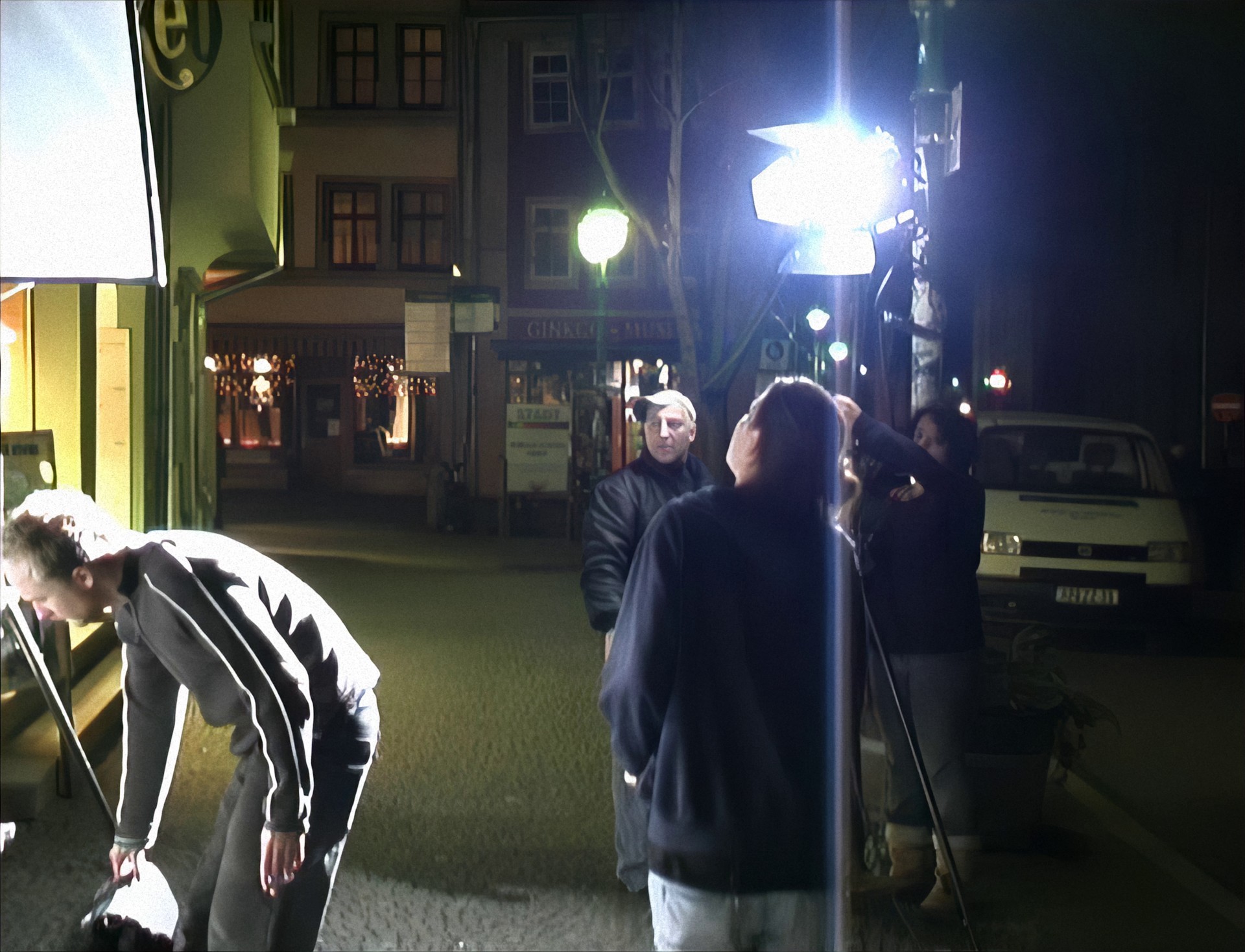
This meant that we would be shining a 1.2 kW spotlight from the street through the window into the café. In addition, there was the crane movement in front of the café. Since the building and its residents had already had problems with the police, the shop owner advised us to obtain a filming permit. And indeed, you have to get approval for this from the market and pay location fees! At night! After an odyssey from one authority to another, we were faced with the following option: if the neighboring jeweler agreed, we could set up the spotlight, otherwise we couldn't. But persuading him was much easier said than done.
Filming
First day
After a sleepless night, I got out of bed at 7:30 a.m. on Tuesday. Doreen had to go to the university in Ilmenau in the morning, so I took care of the first appointments myself. Later, I had to look for an actor for the still vacant role of the bartender. I met with Martin, Carina's lighting assistant, to borrow the van so that he could pick up the lighting equipment from Erfurt. At 1 p.m., we welcomed the actors at the Hotel Amalienhof. After lunch together, I went through the script with Jan and Reinhard. Jan's uncertainty about the text worried me, but Reinhard was able to recite his passages very convincingly. At 5 p.m., Doreen took over and took the two of them to costume fittings. I picked up the van to load the equipment we had ordered from Jean Claude, our university equipment supplier. While loading, I realized what Carina and Egbert had in mind; the van was filled to the brim.
At the same time, Doreen had already started welcoming the film crew and setting up the first equipment at Roxanne. I arrived an hour late with the technical equipment, and after a brief announcement by Doreen as production manager and myself, we got started. I consulted with Egbert, Doreen, sound engineer Constantin, and the stage crew. Everything seemed to be working. Only two problems seemed unsolvable: music was booming over from the student club "C-Keller" next door, and the power supply from the market did not have the right power connection as promised. Nevertheless, Doreen had everything under control and found a solution for everyone. I was able to devote myself entirely to creative questions and went through the text for myself once more. For this "shooting day," the entire part at the table had to be filmed, from Borowski sitting down to everyone standing up together.
At 11 p.m., all preparations were complete as planned, and I brought the actors to the set. After a meal together, we continued: the lighting was adjusted, and I made final arrangements. The first take comprised a total of 10 pages of text, which corresponds to about ten minutes of film. Jan had learned his lines in the meantime, and the performance worked much better than during rehearsals. I was very satisfied and now optimistic about the rest of the shoot. After four takes, the cameras were slightly repositioned for the next take: six pages of text.
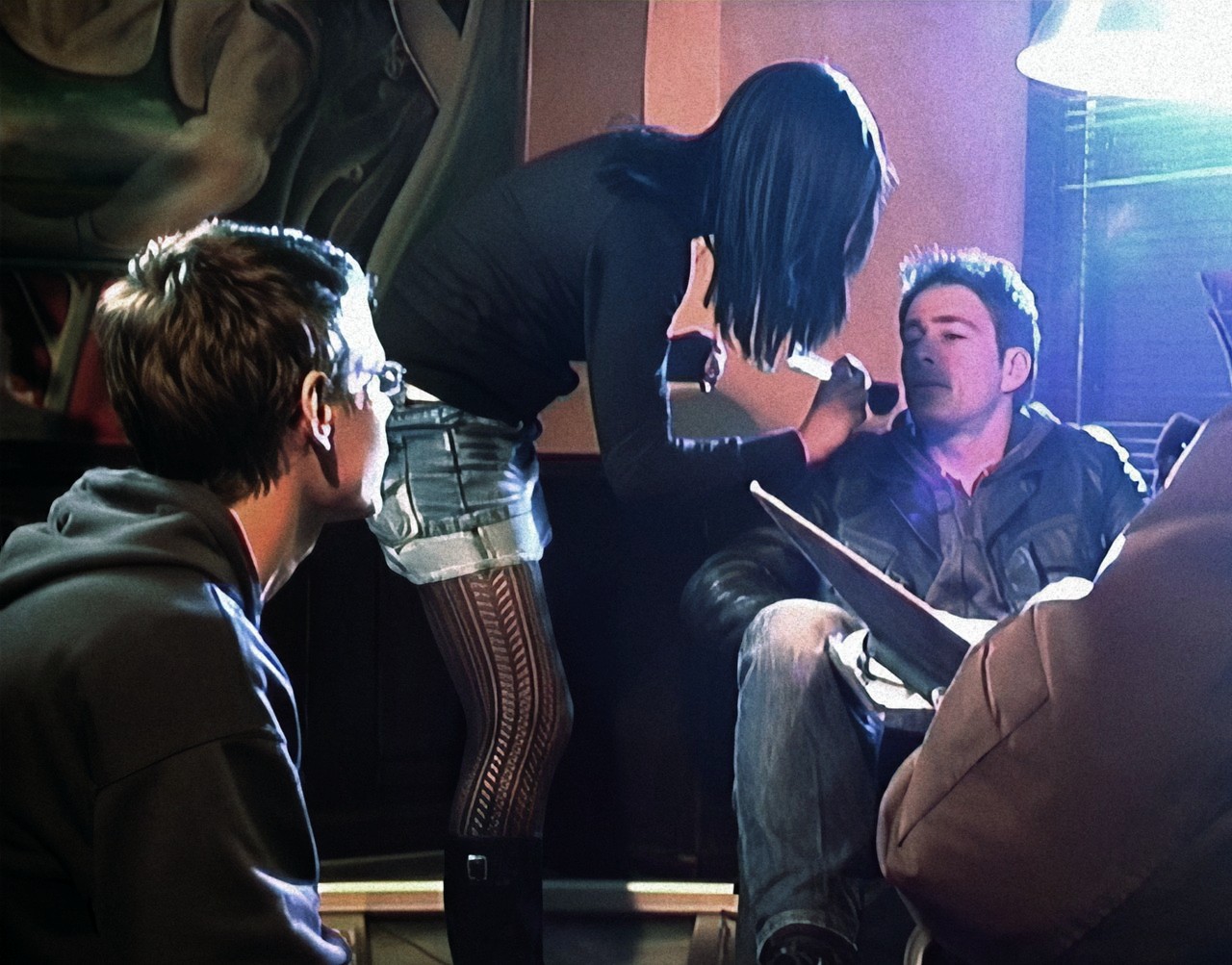
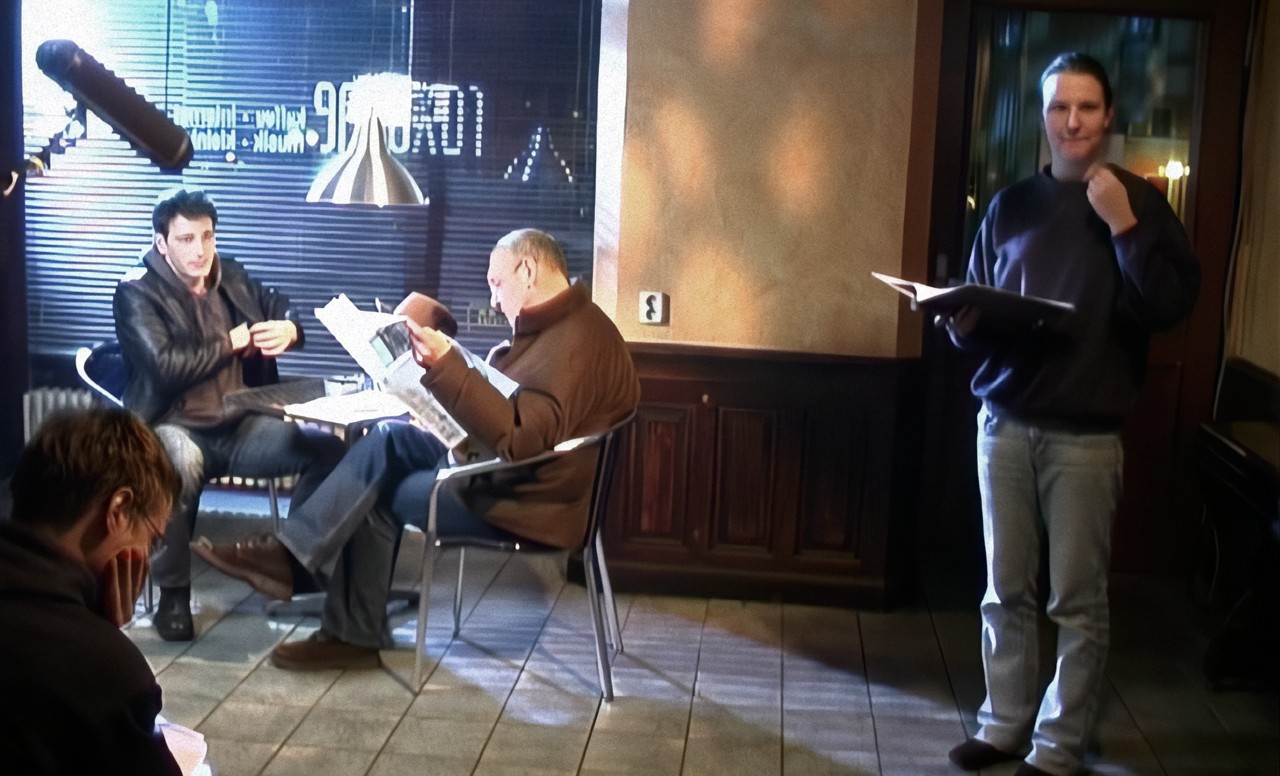
Slowly, I began to feel the strain of the past few days taking its toll. Jan also looked exhausted. But his acting was getting better and better. Reinhard, on the other hand, seemed to be unbeatable. Finally, there were a few close-ups to shoot. Although I tried to fight it, fatigue caught up with me. However, since the actors' movements were clear and it was just a matter of capturing them on camera, we quickly achieved the desired result. At five in the morning, we finally finished shooting. After we had partially rebuilt the set, I fell into bed at six o'clock, exhausted.
Second day
On Wednesday at 1 p.m., it was time to get up again. Doreen and I set out to find an actor for the role of the bartender. A friend from the theater at eWerk gave us the contact details for the Weimar Youth Theater: a certain Max Schreiner. However, he could only give us a non-binding commitment over the phone at first. He would call back later.
At 4 p.m., Doreen and I met up with the lighting crew again to make some changes. With lighting assistant Martin and a few other helpers, we had to clear a lot of space, because that night, all the aisles were to be filmed, as well as the end of the bar. As we all know, lighting takes the most time, but the rest was completely back in place by 7 p.m. So while everyone else got back to work, Doreen asked me to step outside. There was a problem: a live jazz jam session had been announced for that evening from 10 p.m. to 2 a.m. in the C-Keller. This would have been much louder than the night before, and the insulation in the connecting door would certainly not have been sufficient. So it seemed as if we had at least a 4-hour break, 4 hours that we didn't have. After a brief crisis meeting, we agreed to work quickly and do the major renovation from the inside out during this time. Shortly afterwards, Doreen came back to me and told me that the concert had been canceled. Why? She had spoken to the jeweler to ask if everything had been okay the night before and had mentioned in passing that there would be live jazz in the C-Keller. The jeweler knew that they didn't have a permit for this and called the mayor. Everything else went in our favor. Filming began at 9 p.m. We shot the beginning in several possible takes. The demands on the crew were much higher than the previous evening, as we had to change sets more often. The first few hours were rather boring for our actors.
At 11 p.m. we had still not reached Max. I asked an interested passer-by with the right look if he could take on the role. “Sure, why not?” After we had the walk to the bar with him behind him in the box, I went through the situation at the counter with Jan and our new actor: instead of giving out all the money as requested, he should grin in his face and hand him only 20 euros. After a few attempts, I realized he can never play that convincingly. The whole thing looked even worse in the camera. I decided to bring Max in.
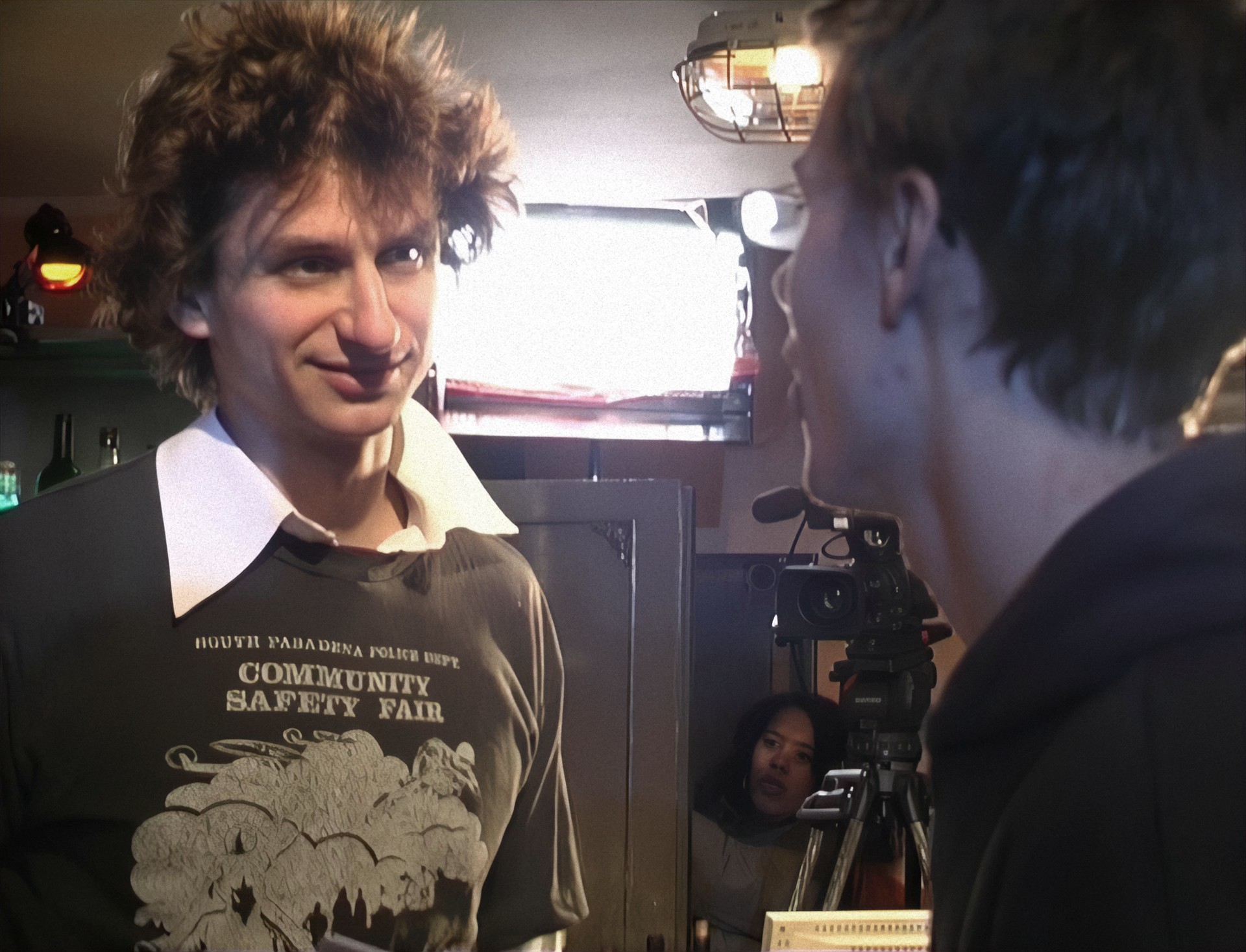
At two o'clock, we resumed filming as normal, but this time with Max as the bartender. We shot the ending at Roxanne's, while Martin set up the crane outside with assistance. Jan's part now consisted solely of lying on the floor, while Reinhard had the most challenging part of his role ahead of him. Working together with Max, he offered me a very emotional variation. This convinced me immediately, and we shot the dialogue again from several angles, but always from beginning to end. Finally, the opening crane shot remained. Carina set about changing the lighting. Reinhard and Constantin went to the now empty C-cellar to record the voice-overs, and I listened to Reinhard's mature narrative voice.
At six o'clock, we started the first crane passes, but the ride was more complicated than expected. The starting and ending points had to be very precise, and the movements of the crane arm had to be completely in sync with the rotation of the camera. After several repetitions, we finally got this shot in the can, thanks to Martin at the remote head. The town hall clock struck seven in the morning.
As the sun slowly rose and the market came back to life, we packed all the equipment back into the van and turned Roxanne back into a café. At some point, Jan came outside. He said a quick goodbye in the leather jacket we had bought for the role of Borowski and wished me continued success. Then he was gone. I watched him for a moment, then realized that the shoot was over. Martin and Carina said goodbye at around nine o'clock; they also needed to get some sleep.
Now Doreen and I had only one problem left: the full van with the valuable equipment couldn't be left unattended. So, exhausted and frozen but happy, we drove through Weimar looking for a breakfast café with a parking lot view. Nothing was open. Finally, Frank Tomas from the equipment rental company allowed us to unload everything at 11 a.m. I was so relieved. Now all we had to do was return the car and the lighting equipment to Erfurt. After 25 hours on our feet, Doreen and I fell into bed at 2 p.m. on Friday afternoon and slept through all our other appointments for the day.
